
Home Delray Beach Short term rental rules
Can you short term rent your Delray Beach home?
It depends on the zoning district your parcel sits in. Not the neighborhood, and not whether it is a house or a condo. This is what the city's code says for each district, how to look yours up, and what a listing needs once the answer is clear.
Verified as of October 2026, against the city's code and the county and state sources listed at the foot of the page. Last checked .
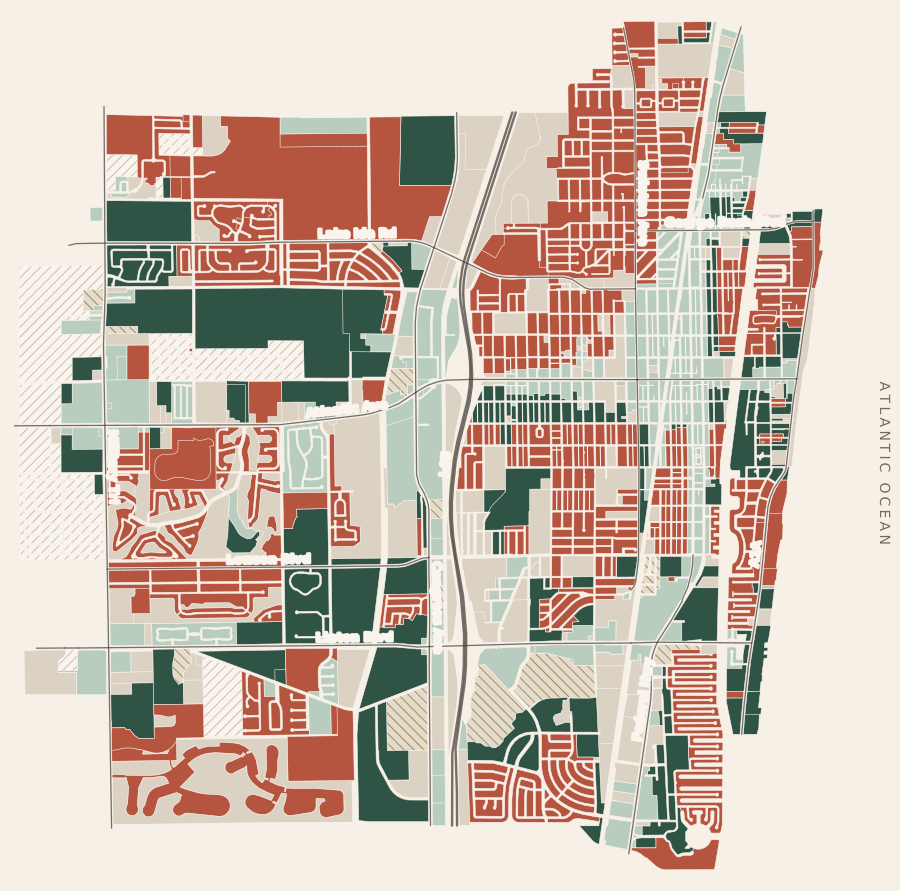
Colored by what the code says
- Restricted R-1 and PRD
- Permitted RM
- No limit in the code CBD, OSSHAD, RL and others
The short answer.
At a glance
- Minimum stay
- None. The city sets no minimum night stay in any district.
- City permit
- No short term rental registration or inspection in the city's code. Two older city items are still being confirmed.
- County tax
- 6 percent tourist tax, filed by the host every month. The platforms do not remit it.
- State license
- A DBPR vacation rental license for the whole unit, renewed every 1 December.
- Single family (R-1) and Planned Residential Development (PRD)
- A home that turns over more than six times in a year is presumed to be a transient residential use, which the code prohibits in these districts. That rules out nightly and weekly renting. Condos and townhomes in PRD communities are covered too.
- Medium Density Residential (RM)
- Short term rental is a listed permitted use, and the code sets no turnover limit and no minimum stay here.
- Most other districts that allow homes
- Downtown (CBD), OSSHAD, RL, RR, RO, GC, PC, MROC and a few others have no short term rental rule in the code at all. That is a reading of the code rather than a written permission, so confirm it for your parcel.
In every district, an accessory dwelling unit can never be rented short term, and a condo or HOA can forbid it on its own.
Look up an address.
Type a street address in Delray Beach. We place it on the City's zoning map and tell you which district it is in and what the code says there.
- Restricted: more than six turnovers a year presumed prohibited, 4.3.3(ZZZ)
- Short term use expressly permitted, 4.4.6(B)(11)
- Homes allowed, no short term limit in the code
- Special Activities District: its own ordinance decides
- Homes not a listed use
- Unincorporated county, not Delray's rules
- City limits
- Downtown
- Atlantic Avenue from about Swinton Avenue east to the Intracoastal, and the Federal Highway corridor, is mostly CBD.
- The beach
- East of the Intracoastal it is parcel by parcel. RM is the most common district on both sides of Atlantic Avenue, but there are large single family blocks north and south of it, some of them on the ocean.
- North of downtown
- Between I-95 and Swinton Avenue, and around Lake Ida Road, it is mostly single family.
- The southeast
- South of Linton Boulevard and east of Federal Highway there are large single family areas, with pockets of RM.
- West of I-95
- A patchwork. Many gated communities are PRD or R-1, and there are large RM blocks between them.
Never assume from the location. The beach and the west of the city change district from one block to the next.
District by district.
Where the table says "no short term rental rule", that is our reading of the definitions, not a sentence in the code granting permission. The code also says a use it does not list is prohibited unless the City rules it similar to one it does (4.3.2(C)(3)), which is why a written confirmation is worth having.
| District | What the code says | Where |
|---|---|---|
| Single familyR-1-A, R-1-AA, R-1-AAA, R-1-AAA-B, R-1-AA-B, R-1-AB | More than six turnovers in a year is presumed a transient residential use, and prohibited. Letting the whole home for under 12 months with more than six turnovers a year is a violation. | LDR 4.3.3(ZZZ) |
| Planned Residential DevelopmentPRD, PRD-4, PRD-5, PRD-6 | The same six turnover presumption. PRD allows duplexes and multifamily, so condos and townhomes in these communities are covered. | LDR 4.3.3(ZZZ), 4.4.7(B) |
| Medium Density ResidentialRM | Short term rental (Transient Residential Use) is a listed permitted use. The code sets no turnover limit here. | LDR 4.4.6(B)(11) |
| RM-6, RM-7, RM-8, RM-9, RM-10 | Mapped as their own codes. We read them as RM; not yet confirmed with the City. | Being confirmed |
| Low Density Residential (RL) and Rural Residential (RR) | No short term rental rule. Both were taken out of the rule by Ordinance 21-26 in April 2026. | LDR 4.4.5, 4.4.2 |
| DowntownCentral Business District (CBD) | Townhouses and multifamily permitted throughout. No short term rental rule. | LDR 4.4.13 |
| Old School Square Historic Arts District (OSSHAD) | Homes, duplexes, bed and breakfasts and residential-type inns permitted. No short term rental rule. | LDR 4.4.24 |
| Residential Office (RO) | Homes, duplexes and bed and breakfast inns permitted. No short term rental rule. | LDR 4.4.17 |
| General Commercial (GC), Planned Commercial (PC), MROC | Homes alongside commercial uses. MROC also allows hotels. No short term rental rule. | LDR 4.4.9, 4.4.12, 4.4.29 |
| Mixed Industrial and Commercial (MIC) | Multifamily only, and only in the I-95 and CSX railroad overlay. | LDR 4.4.19 |
| Agricultural (A), Mobile Home (MH) | No short term rental rule. Rare in practice. | LDR 4.4.1, 4.4.4 |
| Special Activities District (SAD) | Each SAD's own ordinance sets what is allowed. Read the one for your parcel. | LDR 4.4.25 |
| AC, POD, POC, PCC, I, LI, CF, OS, OSR, CD, NC | No homes permitted, so the question does not arise. | LDR Article 4.4 |
| Pockets marked "future annexation" | Not in the city. Palm Beach County's rules apply. | City GIS layer |
How to look up your parcel.
Confirm the address is in the city
Search it on the Palm Beach County Property Appraiser (opens in new tab) and note the municipality and the 17 digit parcel number (PCN). Parcels in the hatched pockets on the map are unincorporated county, where the city's rules do not apply.
Open the city's current zoning layer
Use the City of Delray Beach zoning layer (opens in new tab), search the address, click the parcel and read the district code in the ABRV field, for example R-1-AA, RM or CBD.
Skip the older zoning map
The City's "Interactive Zoning Map" app reads parcel data last edited in September 2022, so it misses anything rezoned since. The layer above has edits through September 2026.
Match the code to the table
If it is SAD, find that district's own ordinance. If it is anything you are about to spend money on, ask the City's Development Services department to confirm the district in writing.
Read the condo or HOA documents
An association can forbid short rentals in any district, RM included. More on that below.
If your home is in R-1 or PRD.
Nightly and weekly renting is out, but the code leaves three doors open.
- Fewer, longer stays
- The rule counts turnovers, not nights. The city sets no minimum stay, so six or fewer turnovers in a year stays inside it, which works out at about two months a stay on average. Seasonal and monthly lets are the model that fits.
- Your own use
- The owners and their family are exempt, however much time they spend there (4.3.3(ZZZ)(1)(c)). Read plainly, that covers your own use of the house. It does not say that renting rooms while you live there is exempt, and the code separately prohibits guest houses (rooms let to travelers). Ask the City before relying on it for that.
- A hardship waiver
- An owner can apply to Development Services for a waiver on grounds of undue economic hardship (4.3.3(ZZZ)(2)). It takes two years of records: purchase price and date, assessments, taxes, mortgage payments, appraisals, any listing for sale or rent, income and cash flow. The City must decide in writing within 45 days of a complete file, and a denial can be appealed to the City Commission. Nobody publishes how often waivers are granted.
What a listing needs.
Once the district is clear, this is the paperwork. Most of it is the county's and the state's rather than the city's, and the tourist tax is a monthly job that never stops.
- Florida vacation rental license
- From the DBPR's Division of Hotels and Restaurants, for a whole unit rented more than three times a year for under 30 days, or advertised as regularly rented. For a single unit: $50 application, $10 hospitality education fee and $170 a year. Palm Beach County is in the DBPR's District 2, which renews on 1 December. Display the license at the property.
- Palm Beach County tourist development tax
- 6 percent on stays of six months or less, charged on the rent including cleaning and pet fees. The host files it every month: due on the 1st, late after the 20th, and a return is required even for a month with no stays. The Tax Collector is plain that online platforms do not remit it. One account per property.
- Short term rental business tax receipt
- From the Palm Beach County Tax Collector, one per tourist tax account: $33 a year, or $16.50 if you start between 1 April and 30 September. Renew by 30 September. It needs no zoning approval, so holding one says nothing about whether the city allows the rental.
- Both numbers on every listing
- The county requires the tourist tax account number and the business tax receipt number to appear in every advertisement.
- Florida sales tax
- 6 percent state sales tax plus Palm Beach County's surtax, collected from the guest and remitted to the Florida Department of Revenue. We are not quoting the county rate until it is confirmed with the DOR; see the open questions below.
- Nothing from the city, as far as the code shows
- We found no city short term rental registration, inspection or local contact requirement in the Land Development Regulations or the Code of Ordinances. Two older city items are still open, below.
Your association can override all of this.
An HOA in Florida can amend its documents to prohibit or regulate rentals of less than six months, and to stop owners renting more than three times a calendar year. Unlike most rental restrictions, those amendments bind every owner, including ones who bought before the vote (Florida Statutes 720.306(1)(h)).
A condominium amendment restricting rentals binds only the owners who vote for it and anyone who buys afterwards (718.110(13)). Either way, one vote can end a short term rental in a district the city is happy with. Read the documents before the zoning answer means anything.
Noise, occupancy and the house rules.
- Noise
- Quiet hours are 10:01PM to 6:59AM across the city (later in the downtown Entertainment District). Sound plainly audible inside a closed home is a violation. Fines are $250 for a first offense and $500 for a second, and up to $1,000 a day, or $5,000 a day for a repeat, through code enforcement. An absentee owner gets no violation notice unless two warnings were mailed in the previous 12 months or it is a repeat, and a property only counts as compliant again after 30 noise-free days.
- Who counts as a family
- The city's definition of family allows no more than three people who are not related, and excludes groups whose association is "seasonal or similar in nature to a resort, motel, hotel". It dates from 2009. Whether the City applies it to short term rental guests is not yet confirmed, so a booking for a large unrelated group is the one a complaint would test.
- Cars and bins
- Leased units are limited to four vehicles for residential parking stickers. Bins go out no earlier than 5:00PM the day before collection and come in by 7:00PM on the day.
- ADUs, guest cottages and rooms
- An accessory dwelling unit can never be used for short term rental, in any district (Ordinance 12-26, April 2026). A guest cottage is for family, non-paying guests or staff, and accessory structures may not be rented separately. A home with rooms let to travelers is a "guest house", which the code prohibits.
- State requirements at the property
- A working lock on every bedroom door that opens to the outside, a hallway or another room. Railings on balconies and stairs in buildings of three or more stories. Carbon monoxide detection where there is a fuel-fired boiler. Linens changed and dishes sanitized between guests.
- Penalties
- A breach of the city code can bring a fine of up to $500 and up to 60 days per offense, with each day a separate offense. A code board can fine up to $1,000 a day for a first violation and $5,000 a day for a repeat. Running without the state license is a second-degree misdemeanor.
Still being confirmed.
These are the questions we have not yet seen answered in writing, by the City or, for the sales tax rate, by the Department of Revenue. We would rather list them than guess, and the page will change when they are settled.
- The city landlord permit. Chapter 117 of the city code still requires a permit to rent any residential unit: $75 per unit a year, from 1 November, tripled if late. Whether the City applies it to vacation rentals is not confirmed.
- A city business tax receipt. Whether the City expects one for a vacation rental.
- RM-6 to RM-10. Whether these mapped codes are treated exactly as RM.
- RL and RR in writing. The code no longer names them in the rule. We would still want that confirmed for a specific parcel.
- The family definition. Whether the three-unrelated limit is applied to short term rental guests.
- The county sales tax rate. The Tax Collector's page says 6.5 percent in total; the Department of Revenue's posted form lists a 1 percent county surtax running to 31 December 2026. Whether Airbnb and Vrbo collect Florida sales tax for Palm Beach County stays is also unconfirmed.
- How the rule is enforced. How actively the City enforces the R-1 and PRD limit, and how often hardship waivers are granted.
The short answers.
It depends on the zoning district of your parcel. In single family (R-1) and Planned Residential Development (PRD) districts, more than six turnovers a year is presumed a prohibited transient use, so nightly and weekly renting is out. In Medium Density Residential (RM) short term rental is a listed permitted use. Most other districts that allow homes have no short term rental rule in the code. Look up your parcel, then read your condo or HOA documents.
No. The city sets no minimum night stay in any district. What R-1 and PRD have is a cap on turnovers: no more than six a year, which averages out at about two months a stay.
We found no city short term rental registration, inspection or local contact requirement in the Land Development Regulations or the Code of Ordinances. Two older city items, a landlord permit and a city business tax receipt, are still being confirmed. The state license and the Palm Beach County tax accounts apply everywhere.
Yes. The rule covers the Planned Residential Development district, and PRD allows duplexes and multifamily, so condos and townhomes in PRD communities are covered. The district decides it, not the type of building.
No. Since April 2026 the code says an accessory dwelling unit shall not be used for short term vacation rentals, in any district. Guest cottages are for family, non-paying guests or staff only.
The host. The tax is 6 percent on stays of six months or less, filed every month, due on the 1st and late after the 20th, with a return required even for a month with no stays. The Tax Collector states that online platforms do not remit it.
No. The Palm Beach County short term rental receipt needs no zoning approval, so holding one says nothing about whether the city allows the use on your parcel.
Ordinance 21-26, adopted 21 April 2026. Florida law bars local rules that prohibit vacation rentals or regulate how long or how often they are rented, unless the rule was adopted on or before 1 June 2011. Delray's single family and PRD rule dates from 2009, so it stands. The rules the City added later, including limits in RL and Rural Residential and a three-turnover cap, were removed, and short term rental was added to the permitted uses of RM.
Yes. Under Florida law an HOA can amend its documents to prohibit or regulate rentals of less than six months, and that amendment binds every owner, existing ones included. A condo amendment restricting rentals binds only owners who vote for it and later buyers. Read your documents before anything else.
Yes. We take homes in Delray Beach and run them the way we run everything else: under your own account, with your listing, your reviews and your Superhost status kept. We do not run a home here today, and we would rather say so. Send us the address and we will look up the district with you first.
Sources.
Verified as of October 2026. Every rule above was read in the published code, ordinance or agency page below on , not from a summary.
- Delray Beach Land Development Regulations, Supplement 35 (includes Ordinance 21-26) (opens in new tab)
- Ordinance 21-26, adopted text and redline, passed 21 April 2026 (opens in new tab)
- Staff report and City Commission agenda memo for Ordinance 21-26 (opens in new tab)
- Delray Beach Code of Ordinances, Supplement 51 (noise, landlord permit, business tax) (opens in new tab)
- City of Delray Beach GIS zoning layer (opens in new tab)
- Palm Beach County Tax Collector, tourist development tax (opens in new tab)
- Palm Beach County short term rental business tax receipt application (Form 44-S) (opens in new tab)
- Florida DBPR guide to vacation rentals (opens in new tab)
- Florida Statutes 509.032 (vacation rental preemption) and related sections (opens in new tab)
- Florida Statutes 720.306 (HOA rental restrictions) (opens in new tab)
- Florida Department of Revenue, discretionary sales surtax (DR-15DSS) (opens in new tab)
This page explains what the published rules say. It is not legal advice and it is not a zoning determination for any property. Rules and fees change; for anything you are about to spend money on, get the district confirmed in writing by the City's Development Services department and speak to a Florida attorney about anything in dispute.
Send us the address.
We look up the district with you first, then come back with what the home would earn, what the county and state paperwork takes, and what we would change before it goes live. If the answer is that it should not be a short term rental, we say so. Or read how we run homes in Delray Beach.
Or call (954) 520-7544.